IdleTask


When to use:
When to use:
- Battery-powered application needs low-power idle mode (Idle() or __WFI())
- Watchdog timer requires periodic servicing (ClrWdt() in background)
- Background processing needed (non-critical communication, diagnostics)
- Visual heartbeat indicator (blink LED at ~1 Hz regardless of task timing)
- Stack usage monitoring or system health checks during idle time
When NOT to use:
- CPU always busy with scheduled tasks (idle never executes)
- Blocking code needed — idle task must execute quickly without delays
- Precise timing required — use hardware timer or scheduled task instead
- Critical operations needed — idle task can be preempted at any time
Block Dialog
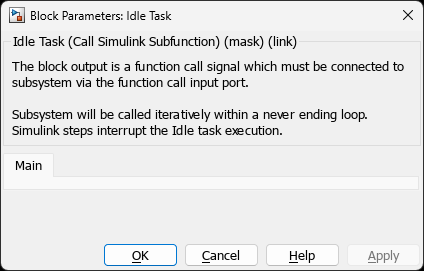
Screenshots taken with chip 33AK512MPS512
Parameters
The idle task is implemented using a Simulink Function-Call Subsystem:
- Add IdleTask block to your model
- Create Function-Call Subsystem and connect to idle task output
- Add background logic inside subsystem
- Keep execution fast - avoid blocking operations
Usage Scenarios
| Application | Description | Example Code |
|---|---|---|
| Power Saving | Enter low-power mode when idle | Idle(); (dsPIC) __WFI(); (ARM) |
| Watchdog Refresh | Service watchdog timer in idle loop | ClrWdt(); |
| Background Communication | Process non-critical messages | Parse low-priority UART data |
| Diagnostics | Monitor system health | Check stack usage, temperature |
| LED Blinking | Visual heartbeat indicator | Toggle status LED |
Best Practices
| Guideline | Reason | Example |
|---|---|---|
| Keep it short | Idle task should execute in <1ms to allow task scheduling | ✓ Increment counter ✗ Complex calculations |
| No blocking | While loops or delays will prevent task scheduling | ✓ State machine ✗ while(flag) wait(); |
| Use persistent variables | Maintain state across idle executions | persistent counter; |
| Avoid critical code | Idle task can be interrupted at any time | ✓ LED toggle ✗ Safety shutdown |
CPU Load Impact
// Idle task execution frequency varies with system load

CPU Load | Idle Executions/sec | Use Case
---------|---------------------|----------

   0%    | ~millions/sec       | Full idle utilization
  50%    | ~500k/sec           | Moderate background work
  90%    | ~100k/sec           | Limited idle time
  >95%   | Sporadic            | Avoid complex idle operations
Power Management Integration
dsPIC Low-Power Modes
| Instruction | Mode | Power Savings | Wakeup Source |
|---|---|---|---|
| Idle() | CPU halted, peripherals run | ~50% | Any interrupt |
| Sleep() | CPU + peripherals halted | ~90% | External interrupt, WDT |
ARM Cortex-M Low-Power Modes
| Instruction | Mode | Power Savings | Wakeup Source |
|---|---|---|---|
| __WFI() | Wait For Interrupt | ~40% | Any interrupt |
| __WFE() | Wait For Event | ~40% | Event or interrupt |
Examples
Example 1: Power-Saving Idle Mode
// Idle Task Subsystem content
// Put CPU to sleep when idle - wakes on any interrupt

function IdleTask()
    % dsPIC family
    Idle();  % Enter idle mode (CPU stops, peripherals run)

    % ARM Cortex-M (alternative)
    % __WFI();  % Wait For Interrupt
end

% Power savings: ~50% reduction in idle current
% Wakeup latency: <10 instruction cycles
Example 2: Watchdog Service
// Keep watchdog from resetting system

function IdleTask()
    persistent counter;
    if isempty(counter)
        counter = 0;
    end

    % Service watchdog every Nth idle loop iteration
    counter = counter + 1;
    if counter >= 1000
        ClrWdt();  % Clear watchdog timer
        counter = 0;
    end
end
Example 3: Background Communication
// Process non-critical diagnostic messages

function IdleTask()
    global DiagBuffer;

    % Check if diagnostic data available
    if ~isempty(DiagBuffer)
        % Process one message per idle iteration
        ProcessDiagnosticMessage(DiagBuffer(1));
        DiagBuffer(1) = [];  % Remove from queue
    end
end
Example 4: Heartbeat LED
// Visual indication of system running

function IdleTask()
    persistent ledCounter;
    if isempty(ledCounter)
        ledCounter = 0;
    end

    % Toggle LED every 500000 idle iterations (~1 Hz at typical load)
    ledCounter = ledCounter + 1;
    if ledCounter >= 500000
        % Toggle status LED
        LATB = xor(LATB, 0x0001);
        ledCounter = 0;
    end
end
Troubleshooting
| Problem | Cause | Solution |
|---|---|---|
| Idle task never executes | CPU always busy with scheduled tasks | Reduce task execution time or lower sample rates |
| System unresponsive | Blocking code in idle task (while loop, delay) | Remove blocking operations, use state machine |
| Watchdog reset | ClrWdt() not called frequently enough | Increase watchdog period or ensure idle executes more often |
| LED blink rate varies | Normal - idle frequency depends on CPU load | Use hardware timer if precise timing needed |
Related Blocks
- MCHP_Scheduler_Options - Task scheduling configuration
- MCHP_MCU_LOAD - Monitor CPU utilization
- MCHP_Tasks_State - Task execution monitoring