C Function Call


When to use:
When to use:
- Integrating legacy C code or existing libraries into Simulink model
- Hand-optimized assembly or C routines needed for performance-critical sections
- Vendor SDKs or third-party libraries required (CAN stacks, sensor drivers)
- Compiler built-ins needed (
__delay_ms(),__builtin_dmaoffset(), etc.) - Custom peripheral register access not available in standard MCHP blocks
When NOT to use:
- Standard MCHP blocks already provide the functionality (use peripheral blocks)
- Complex C code easier to write directly in generated code (use Custom Code blocks)
- Function signature unclear or undocumented — parsing may fail
- Excessive CPU overhead from frequent calls — optimize algorithm in Simulink first
Overview
The MCHP_C_function_Call block enables integration of custom C functions into Simulink models with automatic code generation for Microchip targets. It provides a bridge between Simulink visual programming and custom C code.
Key Features:
- Call external C functions from Simulink
- Automatic parsing of user C files to list available functions
- Support for function inputs, outputs, and return values
- Pin configuration for GPIO requirements
- Execution timing control (every update or once at initialization)
- Optional header file declaration management
Typical Use Cases
- Legacy Code Integration: Use existing C libraries without rewriting in Simulink
- Optimized Algorithms: Call hand-tuned assembly or C routines for performance
- Vendor Libraries: Interface with third-party SDKs and drivers
- Device-Specific Functions: Access compiler built-ins like
__delay_ms(),__builtin_dmaoffset() - Custom Peripherals: Wrap low-level register access in callable functions
Block Dialog
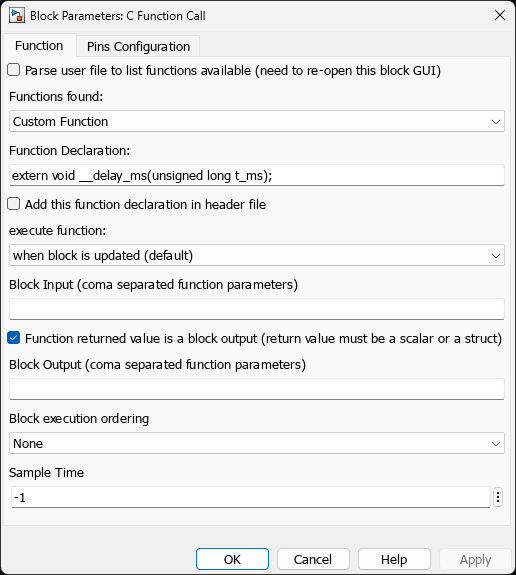
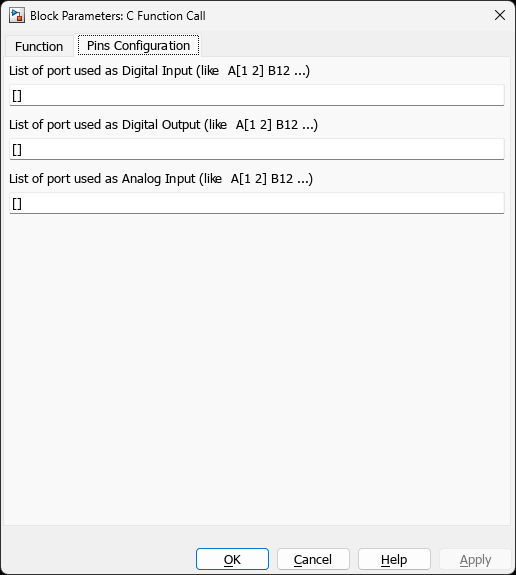
33AK512MPS512Parameters
Function Configuration (Tab 1)
| Parameter | Variable | Description |
|---|---|---|
| Parse user file to list functions | ParseFilesChkbx | When enabled, scans user C files and populates function list dropdown |
| Functions found | ListFunctions1 | Dropdown populated with parsed functions or “Custom Function” for manual entry |
| Function Declaration | Function1 | C function signature (e.g., extern void my_func(int x);) |
| Add this function declaration in header file | AddHeaderDeclaration | When enabled, adds declaration to generated header |
| Execute function | Function1Type | when block is updated (default): Called every sample time only once at power-up time: Called once during initialization |
| Block Input (comma separated function parameters) | Fct1BlockIn | Comma-separated list of parameters passed from Simulink input ports |
| Function returned value is a block output | FctReturnBlockOut | When enabled, function return value becomes a Simulink output port |
| Block Output (comma separated function parameters) | Fct1BlockOut | Comma-separated list of parameters passed by pointer/reference for outputs |
| Block execution ordering | ORDERING | None: Default Simulink ordering Input: Force execution after input dependencies Output: Force execution before outputs consumed Input & Output: Explicit ordering control |
| Sample Time | SampleTime | Block sample time (-1 for inherited) |
Pins Configuration (Tab 2)
| Parameter | Variable | Description | Format |
|---|---|---|---|
| List of port used as Digital Input | PinDigitalInput | GPIO pins configured as digital inputs | e.g., A[1 2] B12 |
| List of port used as Digital Output | PinDigitalOutput | GPIO pins configured as digital outputs | e.g., A[1 2] B12 |
| List of port used as Analog Input | PinAnalogInput | GPIO pins configured as analog inputs | e.g., A[1 2] B12 |
Note: Pin configuration automatically generates TRIS and ANSEL register initialization code.
Common Issues
Function Not Found During Build
Symptom: Linker error undefined reference to 'my_function'
Causes:
- User C file not in model directory
- User C file not added to CustomSource in Code Generation settings
- Function defined in header file only (no implementation)
Solution:
- Ensure user C file is in the model directory, or
- Add file path to Configuration Parameters → Code Generation → Custom Code → Source files
- Verify function is implemented in a .c file, not just declared in .h file
Incorrect Parameter Values
Symptom: Function receives unexpected values or garbage data
Causes:
- Parameter names in Block Input/Output don’t match function signature
- Data type mismatch between Simulink signal and C function parameter
- Missing comma in Block Input parameter list
Solution:
- Verify parameter names in Block Input/Output match exactly (case-sensitive)
- Check data types: Simulink signals must match C parameter types
- Use comma-separated list:
param1, param2, param3(spaces optional)
GPIO Not Configured
Symptom: Pin remains in default state (usually input)
Causes:
- Pin name not added to Pins Configuration tab
- Pin name format incorrect
- Device datasheet uses different pin naming
Solution:
- Add pin to appropriate list: Digital Input, Digital Output, or Analog Input
- Use correct format:
A0orA[0]for single pin,A[0 1 2]for multiple - Verify pin names match device datasheet (some use
RA0, othersA0)
Function Executes at Wrong Time
Symptom: Initialization function runs every step, or step function runs only once
Cause: Incorrect Execute function setting
Solution:
- For functions that run every sample time: select “when block is updated (default)”
- For functions that run once at startup: select “only once at power-up time”
- Verify Sample Time is set correctly (-1 for inherited)
Examples
Example 1: Using Compiler Built-in Delay Function
Goal: Add a software delay using Microchip XC16/XC-DSC __delay_ms() built-in function.
Configuration:
Function Declaration: extern void __delay_ms(unsigned long t_ms);
Execute function: when block is updated (default)
Block Input: (leave empty - parameter name is t_ms)
Function returned value is a block output: OFF
Sample Time: -1
Simulink Model:
[Constant: 10] ──> [C Function Call]
                   (__delay_ms)
Generated Code:
// In model_step() function
__delay_ms(rtb_Constant);
Example 2: Calling Custom Function with Multiple Parameters
User C File (user_functions.c):
void process_data(int16_t input1, int16_t input2, int16_t *output) {
    *output = (input1 + input2) / 2;
}
Block Configuration:
Function Declaration: extern void process_data(int16_t input1, int16_t input2, int16_t *output);
Block Input: input1, input2
Block Output: output
Add declaration in header: ON
Simulink Model:
[Signal A] ──┐
             ├──> [C Function Call] ──> [Output]
[Signal B] ──┘     (process_data)
Generated Code:
// In model_private.h (if AddHeaderDeclaration enabled)
extern void process_data(int16_t input1, int16_t input2, int16_t *output);

// In model_step()
process_data(rtb_SignalA, rtb_SignalB, &rtb_Output);
Example 3: One-Time Initialization Function
Goal: Call a custom initialization function only once at power-up.
User C File:
void init_custom_hardware(void) {
    // Hardware initialization code
}
Configuration:
Function Declaration: extern void init_custom_hardware(void);
Execute function: only once at power-up time
Block Input: (leave empty - no parameters)
Add declaration in header: ON
Generated Code:
// In model_initialize() function
init_custom_hardware();
Example 4: Function with Return Value
User C File:
uint32_t get_cpu_load(void) {
    // Calculate CPU utilization percentage
    return cpu_load_percent;
}
Block Configuration:
Function Declaration: extern uint32_t get_cpu_load(void);
Function returned value is a block output: ON
Block Input: (leave empty - no parameters)
Block Output: (leave empty - return value becomes output)
Simulink Model:
[C Function Call] ──> [Display]
  (get_cpu_load)
Generated Code:
// In model_step()
rtb_Output = get_cpu_load();
Example 5: GPIO Configuration with Custom Function
User C File:
void set_led_pattern(uint8_t pattern) {
    LATB = pattern & 0xFF;
}
Block Configuration - Function Tab:
Function Declaration: extern void set_led_pattern(uint8_t pattern);
Block Input: pattern
Block Configuration - Pins Configuration Tab:
List of port used as Digital Output: B[0:7]
Generated Code:
// In model_initialize()
TRISBbits.TRISB0 = 0;
TRISBbits.TRISB1 = 0;
// ... (B2-B6) ...
TRISBbits.TRISB7 = 0;
ANSELBbits.ANSB0 = 0;  // If device has ANSEL registers
ANSELBbits.ANSB1 = 0;
// ... (B2-B6) ...
ANSELBbits.ANSB7 = 0;

// In model_step()
set_led_pattern(rtb_Pattern);
Implementation Details (click to expand)
Implementation Details
Function Parsing
When “Parse user file” is enabled, the block scans C files specified in:
- CustomSource (Configuration Parameters → Code Generation → Custom Code → Source files)
- CustomHeaderCode (Configuration Parameters → Code Generation → Custom Code → Additional includes)
- CustomSourceCode (Configuration Parameters → Code Generation → Custom Code → Source code)
The parser uses regular expressions to match function declarations of the form:
[extern] [unsigned|signed] <return_type> [*] <function_name>(<parameter_list>);
Recognized data types include:
- Standard C types:
void,char,int,short,long,float,double - Fixed-width types:
int8_t,uint8_t,int16_t,uint16_t,int32_t,uint32_t - Simulink types:
boolean_T,int16_T,uint16_T, etc. - Custom types:
Simulink.Busobjects defined in base workspace
Code Generation
The block generates code using the TLC file MCHP_C_function_Call.tlc:
1. Header Declaration (Optional)
If AddHeaderDeclaration is enabled, the function prototype is added to the generated header:
// In model_private.h
extern void my_function(int x);
2. Function Call Location
Depends on Function1Type parameter:
When “when block is updated (default)”:
// In model_step() via Outputs() section
void model_step(void) {
    // ... other code ...
    my_function(input_value);
    // ... other code ...
}
When “only once at power-up time”:
// In model_initialize() via Start() section
void model_initialize(void) {
    // ... other initialization ...
    init_function();
    // ... other initialization ...
}
Parameter Passing
| Configuration | Generated Code | Description |
|---|---|---|
| Scalar input parameter | LibBlockInputSignal() | Pass by value |
| Pointer/array input parameter | LibBlockInputSignalAddr() | Pass by address |
| Scalar output parameter | LibBlockOutputSignal() | Direct assignment (error if used as parameter) |
| Pointer/array output parameter | LibBlockOutputSignalAddr() | Pass by address |
| Literal value in Block Input | Direct value | Constant passed directly |
| Function return value | output = function(...) | Assigned to first output port if enabled |
Example with mixed parameter types:
Function: extern int my_func(int a, float *b, uint16_t c);
Block Input: a, b, c
Function returned value is a block output: ON

Generated call:
rtb_Output = my_func(rtb_InputA, &rtb_InputB, rtb_InputC);
Pin Configuration Details
The Pins Configuration tab generates initialization code based on port type:
| Port Type | TRIS Configuration | ANSEL Configuration |
|---|---|---|
| Digital Input | TRISx = 1 (input) | ANSELx = 0 (digital mode) |
| Digital Output | TRISx = 0 (output) | ANSELx = 0 (digital mode) |
| Analog Input | TRISx = 1 (input) | ANSELx = 1 (analog mode) |
Pin Format:
- Single pin:
A5,B12 - Multiple pins:
A[0 1 2],B[5:10] - Mixed:
A[1 2] B5 C[7:9]
Generated code example:
PinDigitalInput: A[0 1] B5
→ Generates in model_initialize():
  TRISAbits.TRISA0 = 1;
  TRISAbits.TRISA1 = 1;
  TRISBbits.TRISB5 = 1;
  ANSELAbits.ANSA0 = 0;  // If device supports ANSEL
  ANSELAbits.ANSA1 = 0;
  // ANSELB may not exist depending on device
References
User Functions Overview: Introduction to custom code integration
Master Block: Device configuration and compiler settings
Code Generation: Custom code integration options
Embedded Coder: Custom code integration
S-Function Builder: Advanced custom block functionality